This page provides details of achieving mentoring qualifications with Communication Matters.
The Communication Matters (CM) Mentoring Project aims to deliver qualifications in mentoring for AAC users as well as other training opportunities.
Mentoring is where an experienced Augmentative and Alternative Communication (AAC) user works with a new, younger or less experienced AAC user. The CM Mentoring Project offers qualifications to prepare experienced AAC users to act as mentors.
These fully funded (until July 2029) qualifications are for people aged 13 up to adulthood. There are a number of different entry points depending on the prospective mentor’s skills and communication ability.
The CM Mentoring Project is managed by Verity Elliott; a fully approved assessor accredited by NCFE.
Subscribe to the Peer Support & Mentoring Newsletter
Our newsletter will keep you up to date with training events, and updates on funding, Mentoring qualifications and Communication Clubs across the UK. Click the button below to subscribe.
“I’ve officially completed Level 1 in Mentoring with Communication Matters! Proud to be building skills to support others who use AAC. Here’s to growing, learning, and lifting each other up.”
Becky Tyler
Course content and timing
These qualifications cover topics such as self advocacy, managing your technology, communication skills & assertiveness, digital skills and employability.
Courses are workbook based and are often timetabled for completion between 3 to 12 months.
There is plenty of scope and support available to personalise the learning journey for each individual taking the course.
On this page we share information that is widely applicable to many. Members of Communication Matters will soon be able to explore examples of personalised study plans in our Members Area.
Mentoring Flyers
Click the headings to see leaflets in an expanded view.
Fully Funded: Level 1 Award in Mentoring
Fully Funded: Level 2 and 3 Personal and Social Development
How to enrol
Course enrolment begins with a telephone or online call with Verity Elliott to assess individual communication needs and personalised adaptations to coursework and assessments. Complete the form below to request your call with Verity.
The following qualification structure provides an overview of entry points for Personal & Social Development Certificates/Awards, and Mentoring and Employability Awards.
These mentoring qualifications are fully funded until July 2029.
Entry Level 2 Certificate and/or Entry Level 3 Award in Personal & Social Development
This is often an ideal entry point for younger learners or those less confident with formal learning
Level 1 Award in Personal & Social Development
This may be a further step or an initial entry point for those interested in achieving a mentoring qualification.
Level 1 Award in Mentoring
We anticipate facilitating the student's involvement and interaction with a local mentoring scheme or CM Communication Club.
Level 1 or Level 2 Award in Employability
Course content includes self advocacy, managing your own technology, assertiveness, communication and digital skills and employability.
Request an enrollment call
Please click the button below to book a call to discuss enrolment on the appropriate course for your needs. Please provide complete contact details.
Funding Peer Support and CM Mentoring Projects
Communication Matters was awarded a grant from the National Lottery to continue our AAC Peer Support and CMMentoring Project in England for another five years (2024 – 2029).
Communication Matters has also been successful in receiving funding from National Lottery, Awards for All, Scotland for Mentoring projects in Scotland for the next two years (2026 to 2028).
This enables us to continue to offer a range of opportunities for accredited and non-accredited learning in a wide range of topics including mentoring, peer support and CM Communication Clubs.
Events Diary for Peer Support, Mentoring & Communication Clubs
Dates for 2027 to be announced shortly.
AAC Online Groups & Chats
CM Facebook Groups
We have established two Facebook Groups to support the ongoing effectiveness of Communication Matters’ Peer Support & Mentoring Projects.
The first is for AAC mentors to meet online. You can find this group on Facebook as CM AAC Mentors.
The second is for Communication Club organisers to discuss best practice and share experiences of successful Club activities and organisation. You can find this group on Facebook as CM AAC Communication Clubs.
PWUAAC Online Chats
ISAAC invites people who use AAC to meet online for informal chats. Find details of the next international chat on the ISAAC website.
Learning From Each Other: AAC, Mentoring and Meaningful Futures
By Becky Tyler
I use Augmentative and Alternative Communication (AAC) and communicate using eye gaze. I have cerebral palsy and dyslexia, and today I work across a mixture of areas including speaking, mentoring, accessibility, gaming, content creation and self-employment.
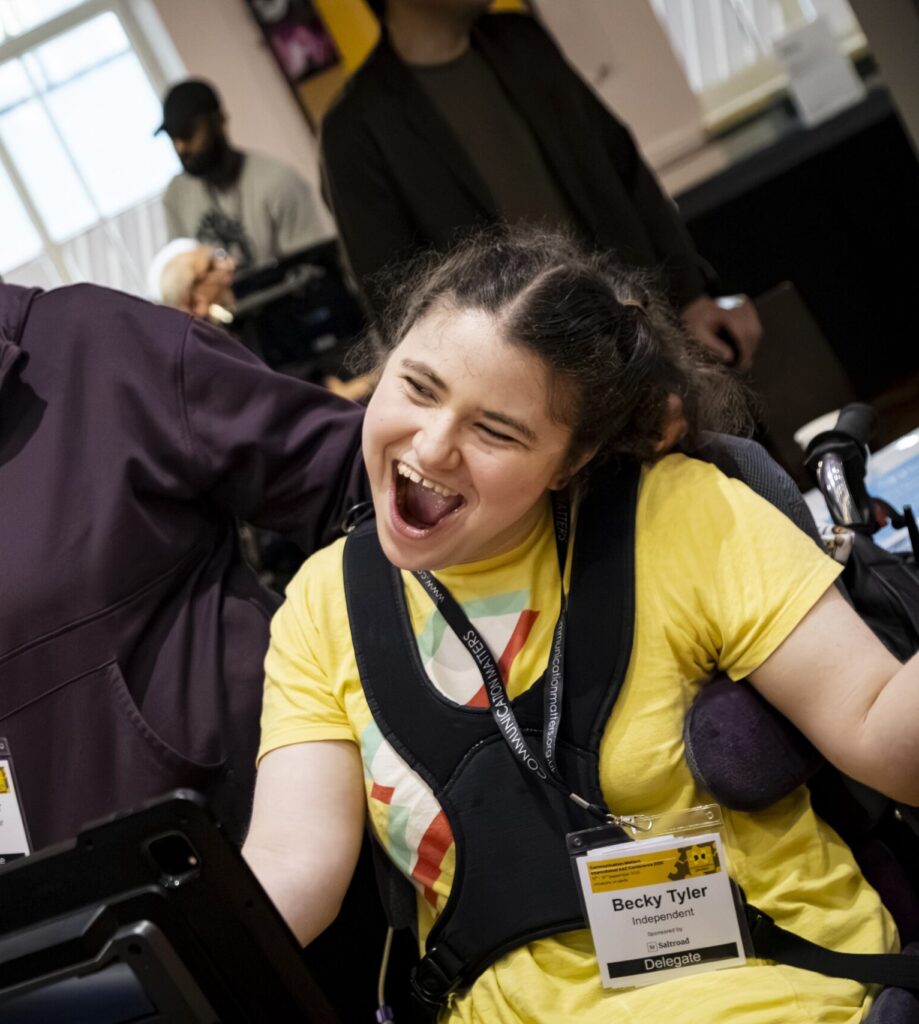
My experiences have taught me that having the right communication technology is important, but communication is about much more than equipment. AAC users also need time, accessible teaching, opportunities to practise, communication partners who listen, and people who believe in our abilities. Most importantly, we need opportunities to shape our own futures.
When communication difficulties are mistaken for lack of ability
Growing up, one of my biggest barriers was not necessarily my disability itself, but the assumptions people made about me.
At primary school, my spelling and phonics difficulties were not properly understood. One teaching assistant worked with me one-to-one on spelling, and I made progress. However, when that support changed, my literacy progress was affected. This also affected my communication. If I did not know how to spell a word and it was not already programmed into my AAC system, it became much harder for me to say what I wanted. My communication difficulties and literacy difficulties could therefore become tangled together.
Later, at secondary school, assumptions about my academic ability became an even bigger barrier. My difficulties with communication and literacy were sometimes confused with difficulties in understanding. I was even told that I would not be able to complete GCSE-level work. But difficulty communicating is not difficulty understanding.
Professionals might see an AAC user giving slow responses, struggling with spelling, producing short written answers, becoming fatigued or taking longer to complete work. What they cannot immediately see are that person’s ideas, knowledge,
creativity, understanding, ambition and potential. Sometimes I gave a short answer not because I had a short thought, but because getting the whole thought out was difficult. That creates an important question for education professionals: What are you actually measuring? Are you measuring somebody’s understanding, or are you measuring how quickly they can communicate it?
Being supported is not the same as being understood
I experienced both mainstream and special education, and support looked very different in each environment.
In mainstream school, having teaching assistants around me made me stand out from the other pupils. In special school, having adults supporting pupils was normal. However, simply having support did not mean I was always understood.
Some staff understood my communication, learning and abilities extremely well. With the right person supporting me, I was more engaged, communicated more and learnt more. Other experiences were very different. If somebody rushed me, did not listen, or assumed they already knew what I wanted to say, I communicated much less. The attitude of the person providing support can therefore be just as important as the support itself. AAC users need people to speak directly to us, allow us enough time to respond and listen to what we actually say rather than automatically looking to the person supporting us.
Success does not have to follow a traditional pathway
Despite being told that GCSE-level work was beyond me, I went on to achieve GCSE-level qualifications and later studied at university. I eventually decided that completing a full university degree was not the right path for me. I achieved a Certificate of Higher Education and moved towards work, advocacy and community projects instead.
Changing direction does not mean failure. My own education taught me that success can take many forms. Several things helped me demonstrate what I could do: accessible communication technology, additional time, receiving materials in advance and having alternative ways to demonstrate my learning.
For example, sometimes a mind map enabled me to demonstrate my understanding more effectively than being required to produce a long written assignment. Good support also encouraged independence rather than creating dependence. The aim should be to maintain ambition while removing barriers .
If an AAC user is struggling to complete written coursework within a standard deadline, the first reaction should not be to ask whether the course is too difficult for them. Instead, ask the person directly what is happening. Consider communication
speed, fatigue, access, literacy difficulties and whether a different assessment method would allow them to demonstrate the same knowledge. Adjust the barrier, rather than lowering the expectation.
Who decides what a meaningful future looks like?
After education, my own future has involved many different things: eye-gaze gaming development, creating accessibility resources, public speaking, training students and professionals, mentoring,
For one AAC user, a meaningful future might involve paid employment or further education. For somebody else, it could involve volunteering, friendship and relationships, creativity, sport, advocacy, community participation or leadership. Often it will involve a combination of these things. What matters is that the AAC user gets to decide what is meaningful.
Teachers, therapists, parents and services can provide support, access and opportunities, but they should not choose somebody else’s future for them.
Instead of asking, “What do we think this person should be doing?”, we need to ask: “What matters to this person?”
From being included to having influence
Inclusion is another area where I think our expectations need to become more ambitious. Simply being present is not inclusion. An AAC user can be physically in a classroom, meeting or event without genuinely being able to participate. Participation is better, but even participation should not be the final goal.
I think of it as a progression:
Present → Included → Listened to → Influential → Leading
AAC users should have opportunities not only to attend activities designed by other people, but to influence decisions and eventually lead. We can be mentors, trainers, advocates, consultants, employees and project leaders. Our lived experience can be expertise.
Real inclusion means creating space for AAC users to shape services and projects from the beginning rather than asking for our opinions once all the important decisions have already been made.
The importance of meeting other AAC users
Peer support also had a major influence on my life. At my special primary school, I was the only pupil who had their own communication device. For a long time, I did not know other people my age who communicated in the same way as me. Then when I was nine, I attended my first 1Voice Residential Weekend, and for the first time, I was surrounded by other AAC users my age. Suddenly, I was not the only one anymore!
Other people understood that communicating can take time. I also discovered that AAC users were not one group of people who were all the same. We had different personalities, interests and ambitions. That experience helped me begin to imagine more possibilities for my own future.
Professional support is important, but peer support offers something different. A professional can have extensive knowledge about AAC, but another AAC user understands what living with AAC every day actually feels like.
Role models can help AAC users feel less alone, develop their identity, learn from shared experiences and raise their expectations of what may be possible. Sometimes seeing another person achieve something simply makes you think, “maybe I could do that too”.
Mentoring and learning from each other
Peer support and role models demonstrate why mentoring programmes and opportunities for AAC users to meet each other are so important.
The Communication Matters Peer Mentoring and Support Project1 creates opportunities for AAC users to connect in person and online, take part in social activities, develop skills, share learning and work together. It also creates opportunities for AAC mentors to co-produce and facilitate activities.
Mentoring should not be seen only as one person helping another – it is an opportunity to learn from each other. The same principle should apply to professionals working with AAC users.
Value lived experience as expertise. Introduce AAC users to peers and role models. Provide information in advance. Allow communication time. Challenge assumptions. Maintain high but realistic expectations and create pathways into leadership.
Above all, speak directly to the person.
Listen to what we say
If there are two messages I would like professionals to remember, they are these:
• Do not just give AAC users a voice. Listen to what we say. Communication technology only creates opportunities if people take the communication produced through it seriously.
And:
• Do not just support us to participate – support us to influence, lead and succeed. AAC users should have opportunities to shape decisions, mentor others, lead projects and use our experiences to improve the world around us.
Access, expectations, peer relationships, role models and the right support changed what I believed was possible in my own life.
Our aim should not simply be helping AAC users to participate in futures designed for them by somebody else. It should be giving AAC users the access, respect and opportunities needed to shape meaningful futures of their own.
Reference:
1. Communication Matters Mentoring Project. https://www.communicationmatters.org.uk/what-we-do/projects/mentoring-project/