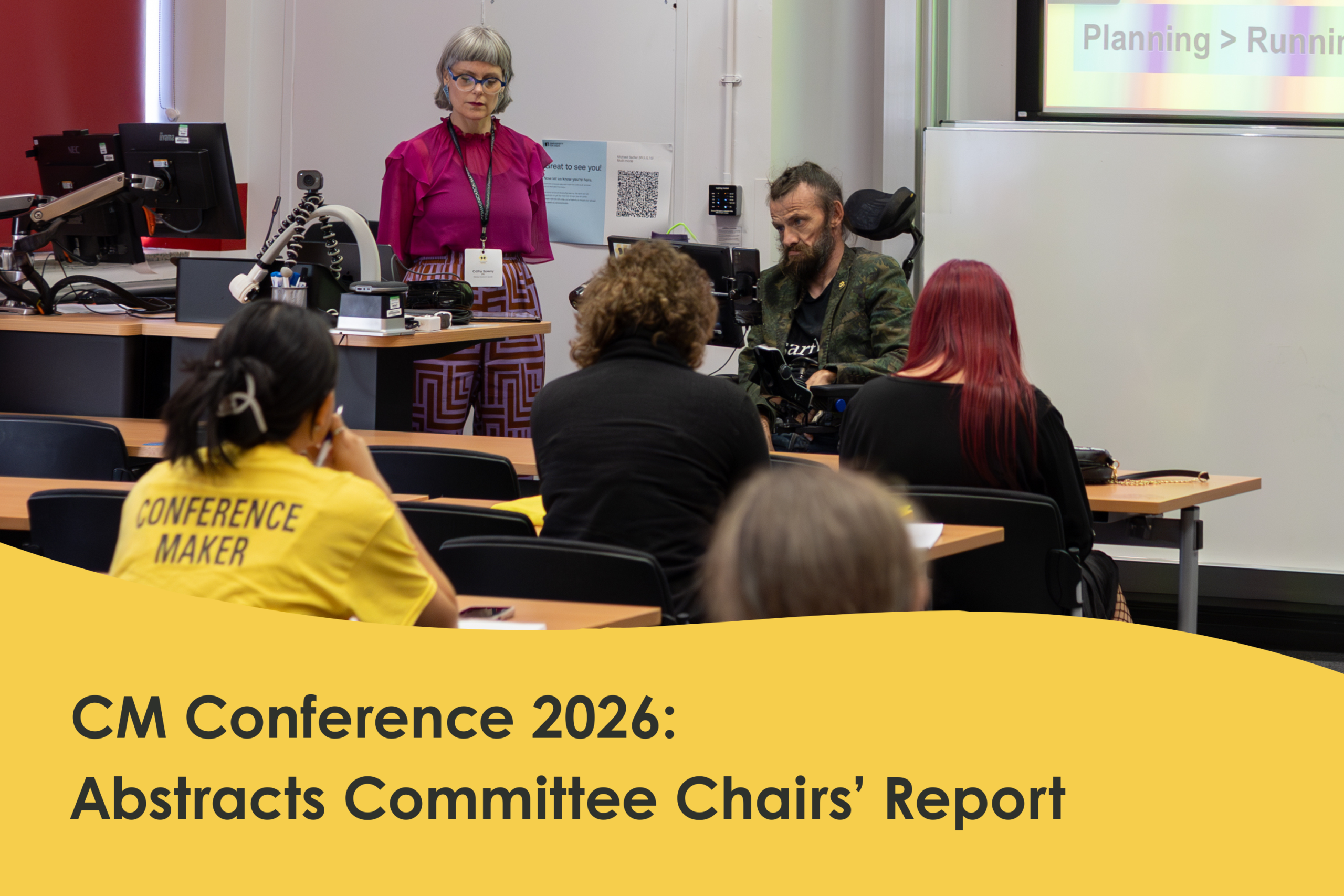
A record breaking 117 people submitted abstracts for the Communication Matters’ International AAC Conference, 13-15 September 2026.
The successful applicants will be receiving their invitations to confirm their places at Conference shortly. Our trustees Helen Hewson and Katherine Broomfield co-chaired to selection process and we share their Chairs’ Report here.
CM Conference Abstracts committee 2026: Chairs Report
This year CM Trustees Helen Hewson and Katherine Broomfield Co-Chaired the Communication Matters (CM) conference abstracts committee consisting of 7 multi-professional reviewers with expertise in the field of AAC. We carefully considered 117 anonymised abstract submissions and were challenged to critically appraise them to generate the content for a programme that has 45 platform and workshop sessions.
We are delighted that the quantity and quality of abstracts submitted for consideration to the Communication Matters International Conference is increasing year-on-year. We accepted 28 international abstracts from 11 countries – a testament to our global reach.We were also pleased to be able to enhance our poster offer this year as we have a large, dedicated space that will provide a fantastic opportunity for delegates to interact with posters and authors which is certain to spark some great discussions and future collaborations. We also recognise that people may experience disappointment and frustration if they do not receive the outcome that they were hoping for from their submissions.
We have collated some reflections from the abstracts committee decision-making process that we hope people will find useful both for reflecting on their abstract submissions this year and when considering what to include in submissions in future.
General Guidelines
- Expand abbreviations on first use – not all reviewers will be experts in your field of practice and may be unfamiliar with abbreviations and acronyms that feel very familiar to you.
- Carefully consider the format you are requesting. Have you got enough content in your proposal to justify a 45 min presentation? Would a lightning talk or poster be a more suitable format? Or can your proposal reasonably be covered in a poster or lightning talk or do you need a longer session?
- Workshop submissions need to specify a practical component for delegate involvement. They should not be used just to gather information but must be sharing new work or ideas too.
- Many of the CM/AAC community wear multiple hats – we are researchers and practitioners, AAC users and researchers, practitioners and AAC users. Consider the content of your abstract when choosing which strand to submit to, rather than your role.
- Some topics are very sensitive, and we need to consider the breadth of our delegates’ perspectives and experiences when considering the suitability of some submissions, especially where there is a risk of causing distress or harm. Abstracts that plan to cover controversial or socially/politically sensitive topics need be substantial – they should contain enough detail to assure the committee that the authors have taken due consideration to the potential risks and mitigations of presenting on such topics.
Personal Stories
- The committee review abstracts without knowing who has written them, so we need information about the context of your proposed talk. Tell us about your experience as an AAC user/family member/carer and what you will talk about during your presentation.
- Provide enough detail so that people will know what to expect from your talk. Use the whole word count. People attending the conference will use the information in your abstract to decide whether to attend your session.
- Support is available if you have an idea but you’re not sure what to write. Talk to a friend, relative, teacher, or professional about your idea and ask them to read your proposal before you submit it and give you feedback. If you’re not sure who to ask – contact the CM office and one of the Trustees will be able to help you or point you in the right direction to access help elsewhere.
- Think about what is new or different about your talk. What will spark other people’s interest or imagination? What will they learn from attending your talk?
Best Research Evidence
- Use a standard approach for presenting your research i.e. background, methods, results, conclusion/discussion
- Clearly detail what data was collected, how it was collected and how it was analysed i.e. your methodology
- Include references where appropriate
- Consider how you can demonstrate the quality of your research i.e. ethics, rigor, trustworthiness, risk of bias, patient and public involvement etc.
- The committee are wary of accepting work in progress, where data is yet to be collected or analysed, as these types of submission pose a risk to our programme integrity i.e. if the work is not completed by conference, we have spaces on our programme or presentations that don’t align to abstracts. If you do not have complete data or analyses, consider submitting project protocols as lightning talks or posters and wait until next year to present your findings and recommendations.
Clinical and professional experience
- Consider what is innovative, novel, or enhanced about what you are proposing. How can you make your abstract stand out?
- Claims need to be substantiated. Report on the data that has informed your practice change/ service development so that others are able to test and replicate it in their practice.
- Avoid repetition – updates on service initiatives presented previously need to be demonstrably different – what new data or insights can you report this year compared to previous years?
Finally, thank you to all those who took the time and effort to submit abstracts to this year’s conference. The abstract review committee consider it a privilege to read and review your work and are always tremendously impressed by the range, standard, and energy of the activity that goes on in the CM/AAC community to advance knowledge, practice, and quality of life.
We have another excellent programme of presentations, workshops, and posters for conference this September. We look forward to meeting you and talking to you all about your work in Leeds.