Read Communication Matters' statements & discover the AAC for All Toolkit
You can find Communication Matters’ responses to Government guidance, reviews and consultations on our AAC for All web page. If you would like to rask questions or amplify your voice on issues that matter to you, you can download the AAC for All Toolkit for guidance and advice on influencing policy makers and government officials.
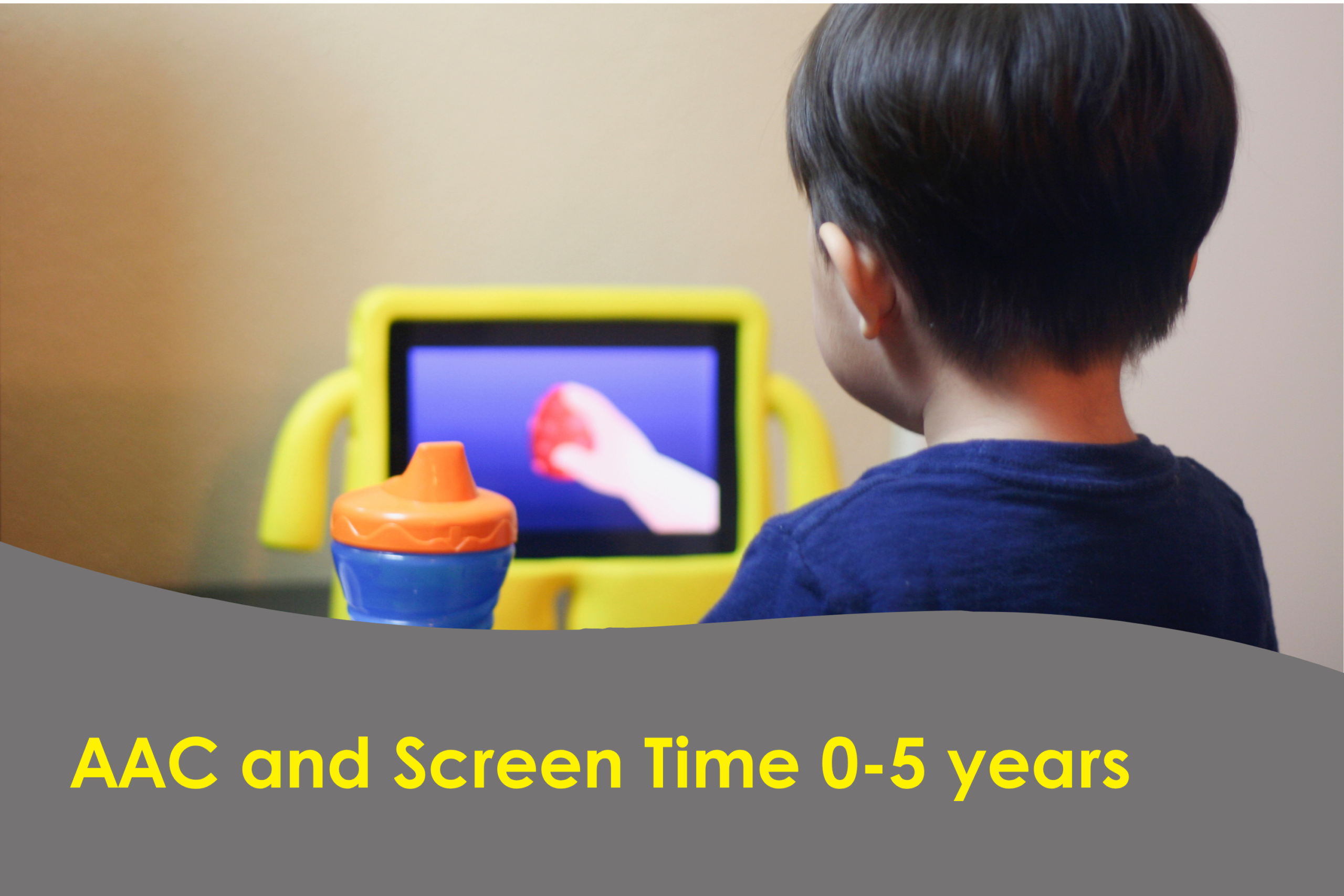
AAC and Screen Time 0-5 years
Communication Matters’ Statement
Communication Matters welcomes the Government review of screen time by the Early Years Screen Time Advisory Group, announced in January 2026. We are in agreement with the Royal College of Speech and Language Therapists that excessive screen time; watching videos, playing games and scrolling, are harmful to children’s cognitive and language overall development. However, Communication Matters also support the various findings that there are positive benefits in homes with language rich environments that include learning through interactive co-viewing; parents sharing screen time, working together and supporting early language development (RCSLT, 2025; Kirkorian et al, 2025; Brushe et al, 2024).
We are concerned that the use of augmentative and alternative communication (AAC) and Assistive Technology (ATech) for learning may be viewed by some professionals and families as screen time without fully understanding how vital these resources are for children with little or no speech when used for developing cognition, communication and connection. AAC and ATech are not entertainment systems but sophisticated digital resources that support communication, connection and learning (RCSLT, 2023).
For most pre-school AAC users their communication devices are provided for communication and connection and not for passive viewing. Communication is a fundamental human right (Bercow, 2008) for all children. AAC resources provide children with little or no speech with their own voice to support their development in the same way as other children. The activities they undertake require the active engagement of a knowledgeable communication partner. Under the guidance of speech and language therapists activities are led by adults, or potentially older siblings, who modelling good communication skills and encourage participation in meaningful activities, including play.
The use of AAC and ATech for communication, connection, educational and therapeutic use, should never be considered to be screen time. When a child is using AAC for communication they are constantly engaging with a communication partner, looking around, watching body language and facial expression, in exactly the same way speaking children do when they interact. AAC is often an alternative pencil to access the curriculum, especially for developing language and literacy once they get to school. Children who are using AAC need the same right to express their wishes, opinions, thoughts and needs in the same way as every other child (Murray, 2004). Having access to AAC without rationing allows pre-school non-speaking children to develop the skills they need to be ready to start school. AAC gives them a voice to be able to develop relationships, advocate for themselves and fulfil their own potential.
For children who use AAC and ATech we need professionals to understand the benefits of bespoke communication and learning packages, encourage joint interactions, modelling and shared learning on a consistent basis in each environment the child accesses. Time limits on usage are not relevant as a child should always have access to their voice. Best practice guidance should be followed for learning to use AAC and families should not be made to feel guilty or shamed that the use of AAC is essential for their child’s cognitive and language development.
References
Bercow, J. (2008). The Bercow Report: A Review of Services for Children and Young People (0-19) with Speech, Language, and Communication Needs. Nottingham: DCSF Publications.
Brushe, M.E., Haag, D.G., Melhuish, E.C., Reilly, S. and Gregory, T., 2024. Screen time and parent-child talk when children are aged 12 to 36 months. JAMA Pediatrics, 178(4), pp.369-375.
Dore et al (2025) Digital Media Use and Language Development in Early Childhood in Christakis, D.A, and Hale. L. Eds. Handbook of Children and screens: Digital media, development and Well-being from Birth Through Adolescence. Springer, Open Access
Kirkorian et al (2025) Digital Media, Cognition and Brain Development in Infancy and Childhood in Christakis, D.A, and Hale. L. Eds. Handbook of Children and screens: Digital media, development and Well-being from Birth Through Adolescence. Springer, Open Access
Murray, J., Barker, S., Blaney, B., Cardador, C., Dunningham, M., Hazell, G., Herd, J., Martin, C., Moulam, B., Preece, J., Radtke, K., Small, K., Sullivan, E., & Whittle, H. (2024b). Position statement: augmentative and alternative communication (AAC) [Online]. Royal College of Speech and Language Therapy. Available at: https://www.rcslt.org/wp-content/uploads/2024/05/RCSLT-AAC_position-statement_May2024.pdf [Accessed 11 June 2024].
RCSLT (2023), Written evidence submitted by the Royal College of Speech and Language Therapists (RCSLT), https://committees.parliament.uk/writtenevidence/125539/pdf/